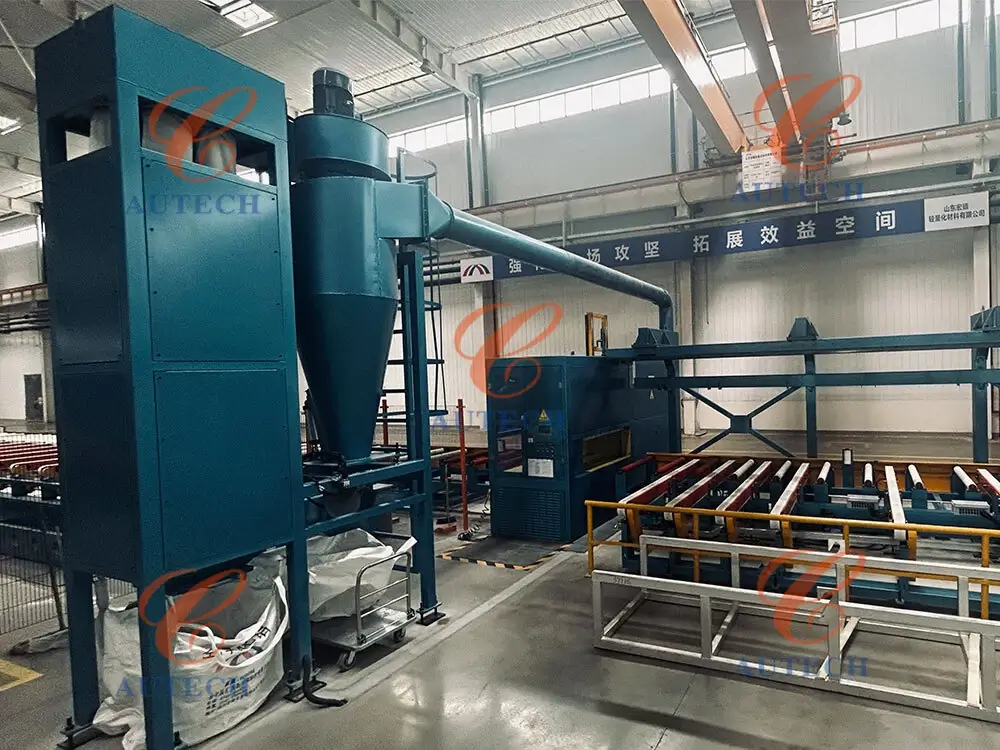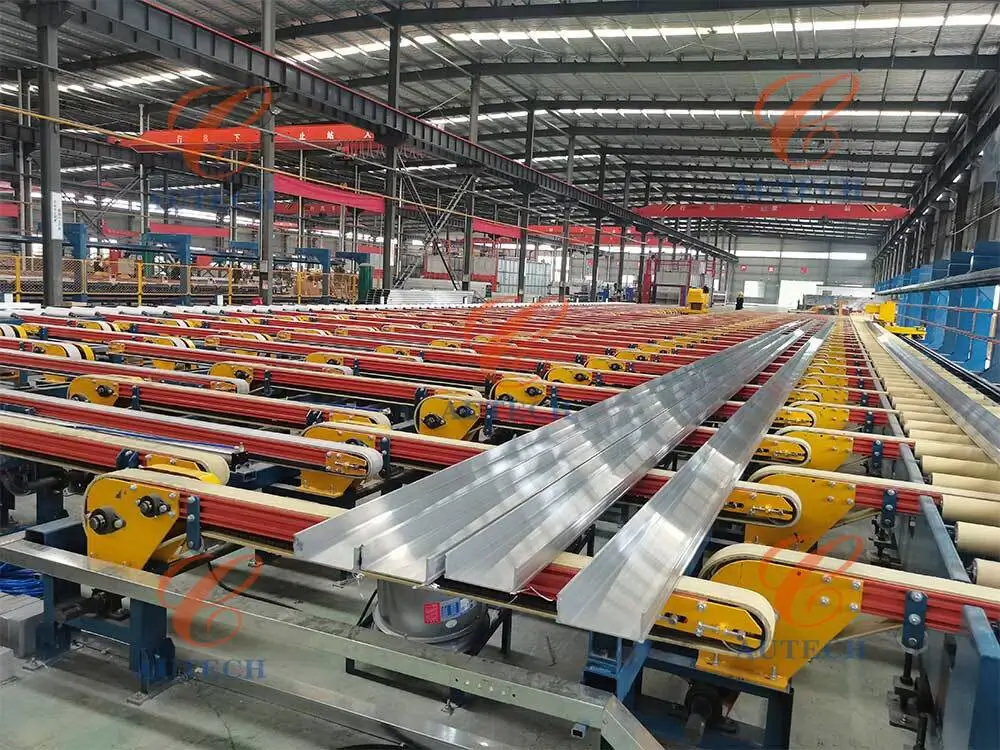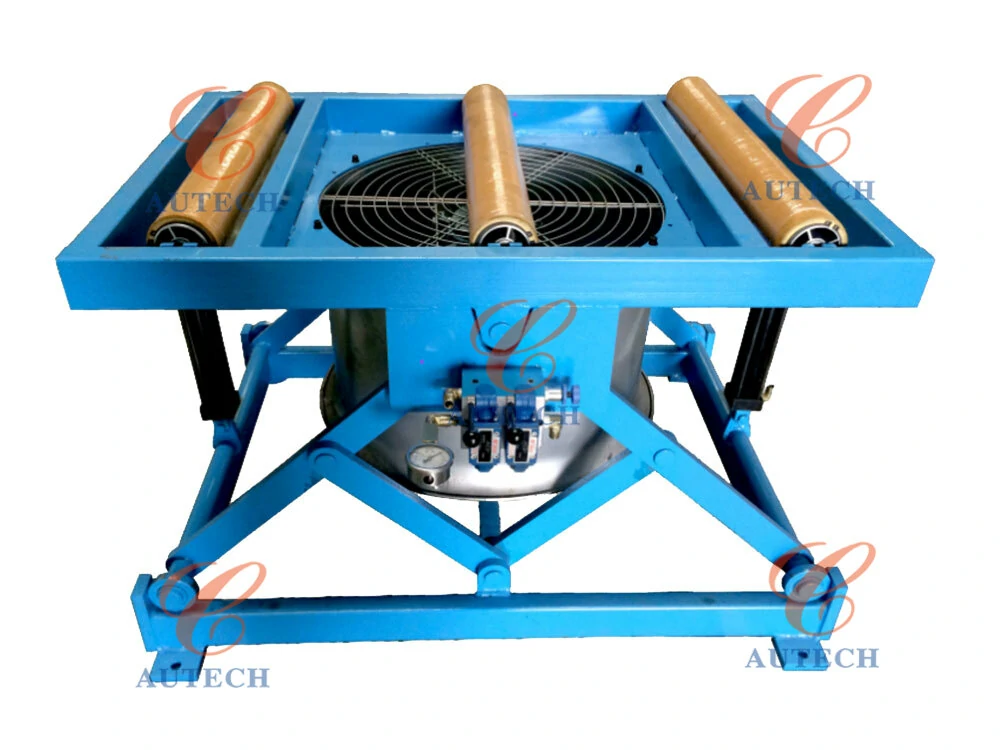

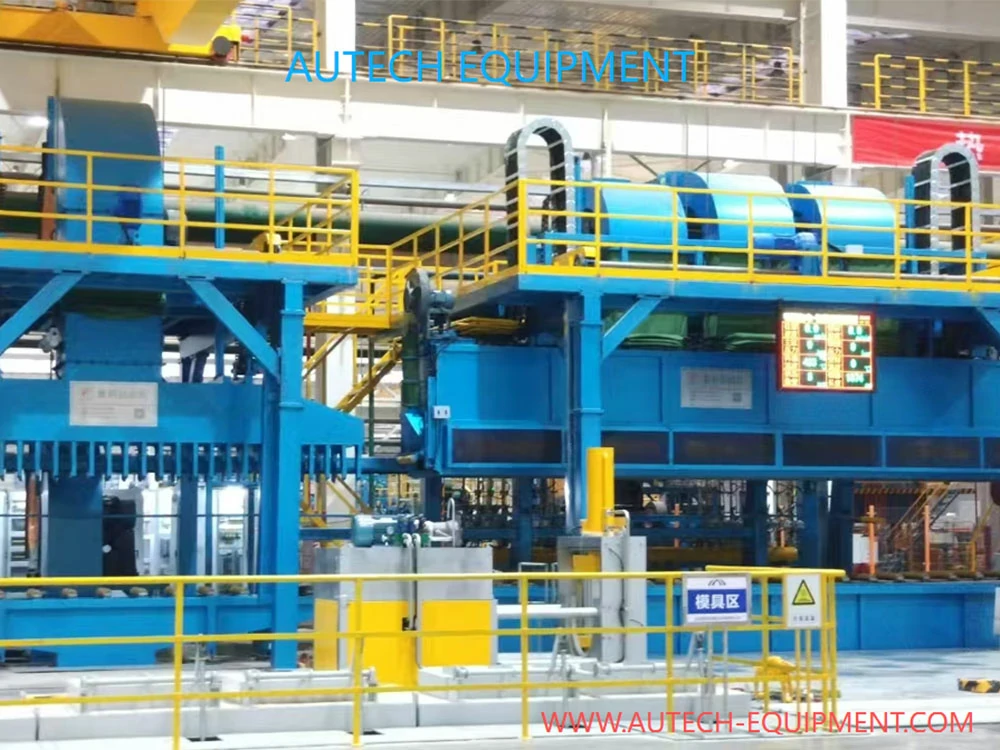
Online quenching occurs immediately after the aluminum profile exits the extrusion die. As the metal is still at its “solution temperature” (usually above 500°C), it is cooled right on the extrusion press’s run-out table.
Core Functions: Rapidly reduces the temperature of the extruded profile to ambient levels using air, water mist, or water baths as it moves along the production line.
Mainstream Models:
Air Quenching Systems: Uses high-velocity fans or blowers. Common for 6063 alloys.
Water Mist/Spray Systems: Uses atomized nozzles for faster cooling. Common for 6061 or 6005 alloys.
Standing Water Wave Quench: The profile passes through a “wave” of water for maximum cooling intensity.
| Advantages | Disadvantages |
| High Efficiency: Integrated into the production flow; no secondary heating required. | Limited to Low-Sensitivity Alloys: Difficult to use with 7XXX or 2XXX series that require extremely high cooling rates. |
| Lower Cost: Saves energy by utilizing the heat already present from the extrusion process. | Risk of Deformation: Non-uniform cooling on the line can cause thin-walled profiles to warp or twist. |
| Space Saving: Eliminates the need for separate solution heat-treatment furnaces. | Control Complexity: Harder to manage precise cooling gradients for complex cross-sections. |
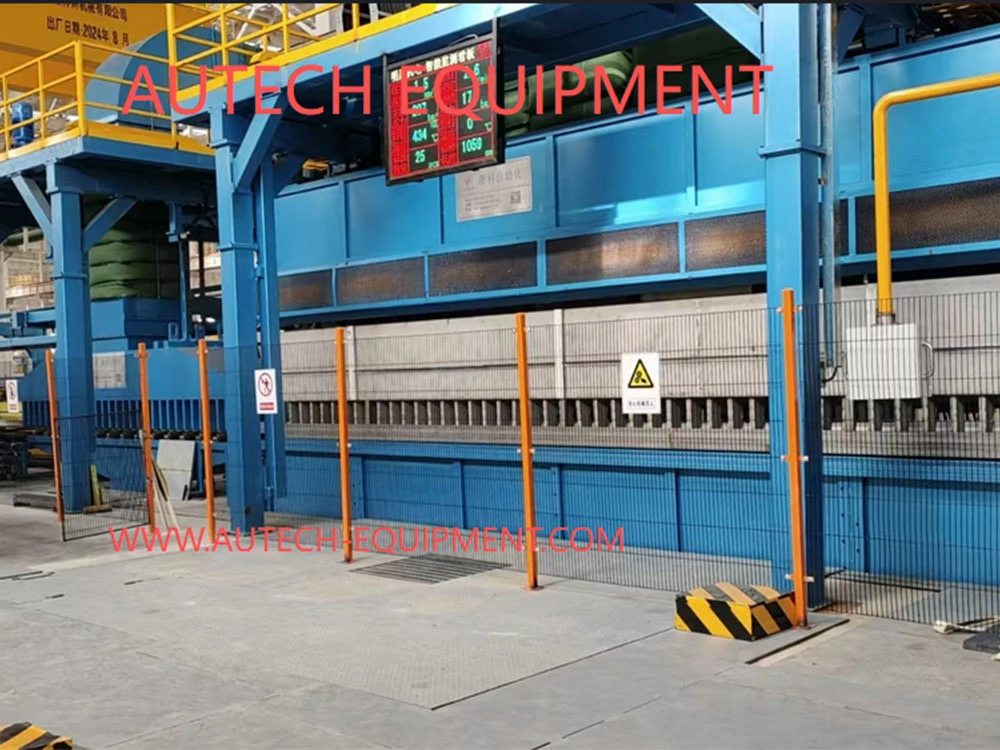
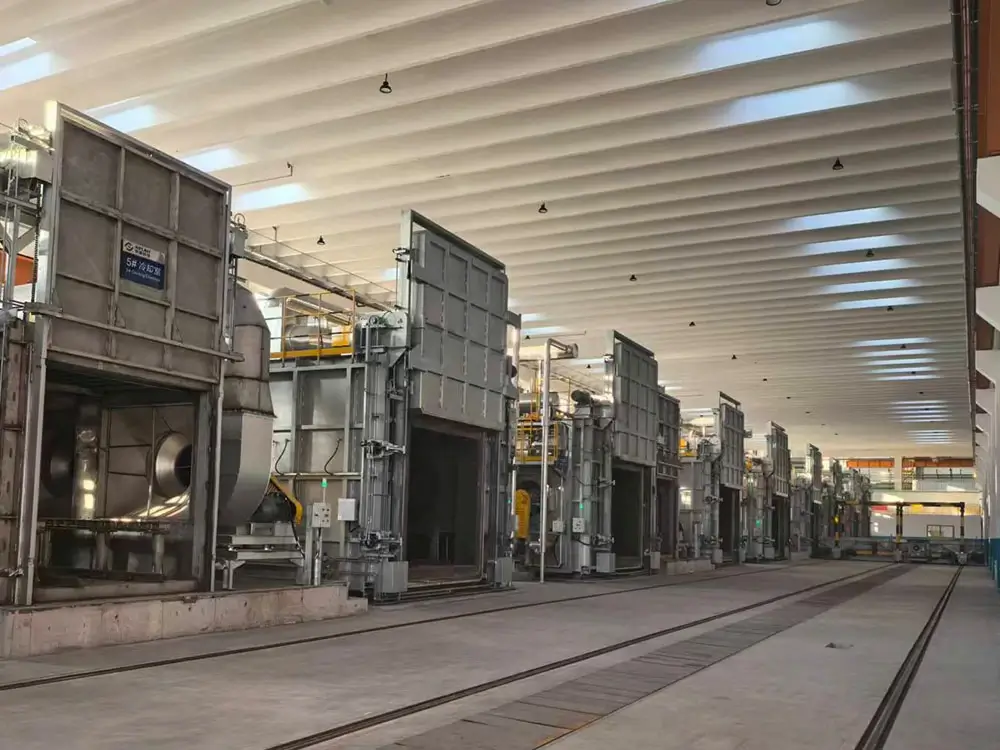
Offline quenching is a separate heat-treatment process. The profiles are first extruded and cooled slowly. Later, they are placed into a Solution Heat Treatment Furnace, heated back up to roughly 520°C, and then dropped or pushed into a quench tank.
Core Functions: Provides a controlled environment to re-dissolve alloying elements and performs a high-intensity quench (usually in a vertical water tank) to ensure metallurgical uniformity.
Mainstream Models:
Vertical Quenching Furnaces: Profiles are hung vertically and dropped into a deep water pit. This is the industry standard for aerospace and high-strength structural parts to minimize warping.
Horizontal Batch Furnaces: Used for smaller parts or specific forged components.
| Advantages | Disadvantages |
| Superior Strength: Necessary for high-strength alloys (2XXX, 7XXX) that need precise metallurgical control. | High Energy Consumption: Requires reheating the metal from room temperature to over 500°C. |
| Better Dimensional Stability: Vertical quenching significantly reduces gravity-induced bending and distortion. | Slow Production Cycle: Adds a major time-consuming step to the manufacturing process. |
| Uniformity: The entire batch reaches a precise temperature before quenching, ensuring consistent hardness. | High Investment: Requires expensive separate furnaces and large water-handling systems. |
| Feature | Online Quenching | Offline Quenching |
| Timing | Immediately after extrusion | Separate process after cooling |
| Primary Alloys | 6061, 6063, 6005 | 2024, 7075, 5083 |
| Cooling Medium | Air or Water Spray | Deep Water Tank (Immersion) |
| Cost | Low (Economic) | High (Premium) |
| Application | Architecture, general transport | Aerospace, Military, Structural |